
Rock Hill Ford – Which is better for unpaved backroads around Fort Mill, SC — the 2026 Ford Bronco Sport or the 2026 Jeep Compass?
When you’re deciding between two capable compact SUVs for the mix of cul-de-sacs, construction zones, and occasional dirt cut-throughs around Fort Mill, SC, one question consistently rises to the top: which vehicle gives you more confident traction and control on imperfect roads without sacrificing daily comfort? The 2026 Ford Bronco Sport and the 2026 Jeep® Compass both deliver standard 4×4, approachable size, and modern tech. Yet the way each brand tunes its hardware and driving modes creates distinctly different experiences for the same commute.
This guide breaks down the traction systems, off-road aids, suspension character, interior tech, and towing confidence that matter most on the backroads and bypasses you tackle every week. Whether your weekends swing from Anne Springs Close Greenway to a tool run on Highway 160, you’ll find clear, practical reasons why one of these SUVs fits that rhythm better than the other.
How traction systems shape confidence
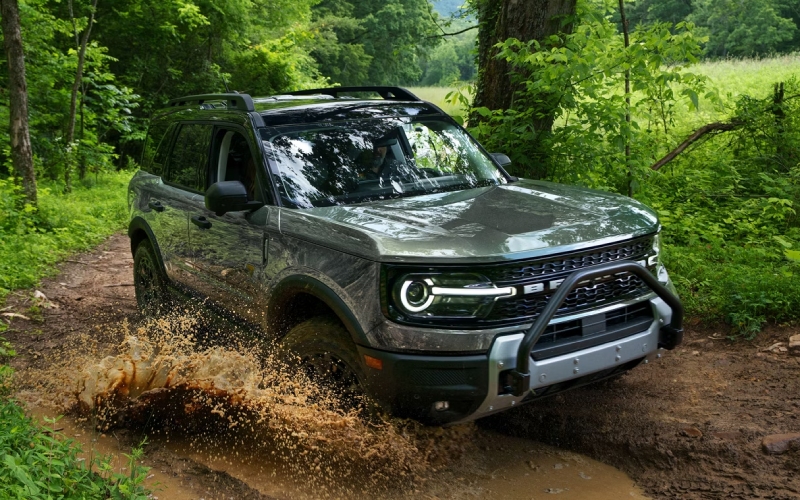
Both SUVs send power to all four wheels, but they go about it differently. Bronco Sport uses G.O.A.T. Modes® to adjust throttle response, shift mapping, and traction control for different surfaces. On Badlands®, Advanced 4×4 adds a twin-clutch rear drive unit that can route nearly all rear-axle torque to a single wheel for powerful pull when one side loses grip. In real terms, that means fewer frantic throttle stabs to climb a loose driveway or crest a rutted path. The Jeep Compass applies Jeep Active Drive 4×4 and Selec-Terrain® with modes like Auto, Snow, Sand, and Mud, and on Trailhawk® you get Rock Mode. It’s effective, but without the twin-clutch torque vectoring hardware, the Jeep relies more on brake-based traction strategies where the Ford can directly shift torque side to side.
Suspension character on bumpy pavement
Unpaved connectors and patchworked neighborhood streets can amplify harshness. The HOSS Off-Road Suspension in Bronco Sport is tuned to filter out chatter while keeping the body settled, so you’re not constantly catching secondary motions after a pothole or washboard ripple. Jeep’s chassis is composed as well, and Trailhawk® adds all-terrain tires that help over rougher surfaces. Day to day, though, the Ford’s suspension calibration feels more dual-purpose: supportive and calm on I-77, yet ready when you swing onto a gravel lane to beat traffic.
Cabin tech that actually helps on rougher routes
When pavement quality dips, clarity and simplicity matter. The Bronco Sport’s 13.2-inch center display gives you bigger mapping tiles, larger on-screen buttons, and easier at-a-glance info. Wireless Apple CarPlay® and Android Auto™ are standard, and the Ford Connectivity package is included for one year to support streaming and Wi-Fi® hotspot capability for road trip navigation or quick work calls from a trailhead. The Jeep Compass counters with Uconnect® 5 and a sharp 10.1-inch touchscreen plus an available 10.25-inch Digital Cluster. Both are modern and user-friendly, but the Ford’s larger main screen makes a difference when you’re bouncing along and want unmistakable map prompts or camera views.
Real-world towing and utility
Even in compact SUVs, towing headroom matters. If your weekend includes a pair of kayaks and a small utility trailer for lawn gear, Bronco Sport offers up to 2,200 pounds of towing when properly equipped. Compass tows up to 2,000 pounds when properly equipped—solid for a lot of uses but with a bit less margin if your load shifts or you’re pulling uphill with a full cabin. Around the Charlotte metro fringe where rolling grades and short on-ramps meet, that extra buffer is reassuring.
Ownership experience and local fit
The best traction system is the one you trust enough to use on a busy Thursday, not just on a once-a-year trail day. Bronco Sport’s blend of standard 4×4, G.O.A.T. Modes®, and available Advanced 4×4 with twin-clutch torque vectoring makes it feel planted and predictable on those cut-through gravel stretches off Springfield Parkway or Banks Road. Compass remains a solid companion, and Trailhawk® is authentically trail-focused, but its traction strategy is a touch more conservative in mixed-use driving. For many Fort Mill drivers who toggle between suburban errands and light adventure, the Ford’s confidence-inspiring tuning hits the sweet spot.
- Traction strategy: Bronco Sport’s available twin-clutch rear drive unit can proactively send torque to the wheel that needs it most; Compass uses brake-based strategies without an equivalent torque-vectoring rear axle.
- Ride-and-handling balance: HOSS Off-Road Suspension is tuned to absorb chatter without float; Compass is composed but not as dual-mission focused.
- Usability & screen size: The Ford’s 13.2-inch screen makes maps and menus easier to read on bumpy pavement; the Jeep’s 10.1-inch unit is clear but smaller.
Of course, both SUVs bring extensive driver-assist technologies. Bronco Sport offers Ford Co-Pilot360® Assist+ and connected security features; Compass offers available Active Driving Assist, Drowsy Driver Detection, and a high-strength steel body. If your priority is a cohesive system that fades into the background until you need it, the Ford’s suite feels especially well integrated for daily use.
Frequently Asked Questions:
Which SUV provides more confident traction on loose surfaces?
Bronco Sport’s standard G.O.A.T. Modes® and available Advanced 4×4 with a twin-clutch rear drive unit deliver particularly strong control on gravel, mud, and uneven paths. Compass is capable—especially in Trailhawk®—but lacks the Ford’s torque-vectoring rear axle.
Does the larger screen in Bronco Sport really matter on rough roads?
Yes. The 13.2-inch display gives you bigger targets for taps and clearer mapping at a glance, which reduces distraction on bumpy surfaces. Compass’s 10.1-inch screen is good; the Ford’s is simply larger and easier to read.
How do these SUVs fit everyday life if I tow occasionally?
Bronco Sport offers up to 2,200 pounds when properly equipped, while Compass offers up to 2,000 pounds. Both can handle small trailers, but the Ford’s added margin helps on short, uphill merges when loaded with passengers or gear.
Ultimately, your choice comes down to how often you drive on imperfect surfaces and how much you value a more proactive traction system. If you want an SUV that feels calm and composed on the 77-485 weave yet ready for a rutted shortcut after soccer practice, the Ford aligns neatly with that routine. Rock Hill Ford, serving Monroe, Fort Mill, and Indian Trail, can walk you through each system in detail and set up a route that mimics your daily drive so you feel the differences firsthand.
We encourage a back-to-back drive over a mix of surfaces so you can feel the distinct character of each model. One loop is often all it takes to see why Bronco Sport’s torque management, screen design, and suspension tuning add up to a calmer, more confident experience on the roads you actually drive.
If you’re ready to dig deeper or want to validate how these differences feel on your commute, our team is happy to help you compare features, set drive modes, and evaluate towing needs—all without pressure. That’s the best way to answer the original question for your life, your roads, and your weekend plans.
For availability, trims, and a hands-on walkaround, reach out to our team at Rock Hill Ford and bring your real-world questions—we’ll bring the keys.
Request more 2026 Ford Bronco Sport information
Connect with us


