

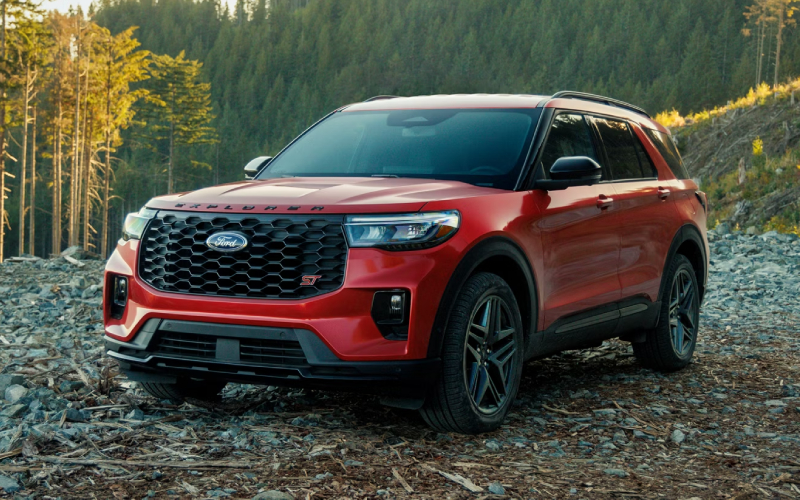
Rock Hill Ford – Which three-row SUV has the more advanced hands-free driving tech for York, SC families — 2026 Ford Explorer or 2026 Toyota Highlander?
When local families ask about hands-free driving features, they’re often comparing two favorites: the 2026 Ford Explorer and the 2026 Toyota Highlander. Both SUVs offer robust driver-assist suites designed to reduce stress and support confident decision-making, but they go about it differently. If your daily loop swings from neighborhood streets to I-77 and back again, understanding where each system shines — and where one clearly outpaces the other — can simplify your decision.
Here’s the simple breakdown: Explorer offers available BlueCruise, a hands-free highway driving assistance feature for use on compatible divided highways. Highlander, by contrast, includes Toyota Safety Sense 2.5+ with helpful features like Lane Tracing Assist, but it does not provide hands-free operation. That singular difference resonates on real highways around York, SC, where long commutes, after-school shuttles, and weekend tournament trips put a premium on reducing driver fatigue without compromising control or awareness.
What does “hands-free” really mean — and where does it work here?
Hands-free means the system can assist with acceleration, braking, and steering on pre-mapped, compatible highways while the driver remains attentive with eyes on the road. BlueCruise is engineered for divided highways where traffic flow and lane markings support safe, predictable operation. Around York, that can mean stretches of I-77 and I-485, as well as other mapped corridors you may use to reach airports, ball fields, and weekend destinations. The Chevy vs. Ford debate often lives in the towing arena; here, when it’s 2026 Ford Explorer vs 2026 Toyota Highlander on the highway, Explorer’s capability is less about raw muscle and more about giving you a break when it matters most.
Highlander’s Toyota Safety Sense 2.5+ does a great job with active support: it can help keep centered in-lane, follow a vehicle at a set distance, and alert you to hazards. Drivers who spend most of their time on surface streets may find that suite entirely sufficient. But if your schedule includes extended highway time — work commutes, club sports, or family road trips — BlueCruise’s true hands-free assistance is purpose-built for those exact scenarios.
How does BlueCruise feel compared to “hands-on” lane support?
BlueCruise complements your natural flow. Once you’re on a compatible highway and conditions are met, the system manages the steady-state driving tasks with remarkable composure. It won’t replace your attention — your eyes remain on the road — but it reduces the subtle workload that adds up over 30, 60, or 90 minutes behind the wheel. In the Highlander, Lane Tracing Assist feels smooth and reassuring but remains a “hands-on” technology; your hands stay on the wheel, and steering support is more of a helper than a driver-steadying partner.
That difference is easy to sense on the long arc from the state line to South Charlotte or up to the lake area on a Friday evening. BlueCruise maintains lane position and distance with a confidence that makes conversations easier and fatigue grow slower. It’s the kind of feature you don’t think you need until the day you realize you arrived fresher and more focused.
Beyond the drive: how Explorer and Highlander support families
Safety tech is only part of the conversation. Explorer layers in the B&O® Sound System by Bang & Olufsen® (available) for crisp calls and music, a 360-Degree Camera to simplify parking near busy ball fields, and available heated, ventilated, and massaging front seats for real comfort on long days. Highlander answers with available 12.3-inch displays, a Panoramic View Monitor, and a thoughtful cabin layout that can seat up to eight. Both tow up to 5,000 lbs, which is more than enough for many family trailers and small boats.
Where power and composure matter, Explorer’s available 3.0L EcoBoost® V6 and Max. Avail. Horsepower of 400 hp make highway merges and hilly routes feel effortless. Highlander’s turbocharged 2.4L gas engine is smooth and strong for daily needs, and the available Hybrid option appeals to drivers who want an electrified alternative. If your routine mixes urban errands with weekly highway commitments, you’ll likely feel the Explorer’s extra power in the moment that counts — a clean pass before the next exit or a steady climb with a full load.
Test-driving the difference around York, SC
To truly compare, focus on your everyday realities. Plan a route that includes a compatible highway segment for BlueCruise and a few surface streets for parking, roundabouts, and traffic lights. Bring the family, fold seats, and simulate a typical week — groceries, sports equipment, and a couple of backpacks. In Explorer, engage BlueCruise when conditions allow; in Highlander, try Lane Tracing Assist and Adaptive Cruise Control in comparable traffic. Note how each SUV handles interruptions — lane shifts near construction, tighter merges, and the stop-and-go patterns that define late afternoons near retail corridors.
Also think about your towing needs. If you occasionally pull a small camper or a pair of personal watercraft, both SUVs can handle it. But the RWD-based platform and available hardware upgrades on Explorer can give it a planted, composed feel with a trailer attached — especially helpful when you’re leaving a lakeside launch on a sloped, damp surface.
Quick highlights you can feel in a test drive
- Hands-free capability: Explorer’s BlueCruise provides true hands-free assistance on compatible highways; Highlander does not offer hands-free operation.
- Highway confidence: Explorer’s available 3.0L EcoBoost® and 400 hp create effortless passing power; Highlander’s gas engine is capable but less forceful.
- Parking and maneuvering: Both offer bird’s-eye camera views that help in tight athletic complex lots and busy shopping areas.
- Comfort for long days: Explorer’s available massaging front seats and premium audio can reduce fatigue; Highlander counters with expansive displays and an available panoramic roof.
Frequently Asked Questions:
Is BlueCruise available on every Explorer trim?
BlueCruise is available on select Explorer trims and helps with acceleration, braking, and steering on compatible divided highways while you remain attentive with eyes on the road.
Does Highlander offer a hands-free driving feature like BlueCruise?
No. Highlander includes Toyota Safety Sense 2.5+ with lane centering and adaptive cruise functions, but it does not support hands-free highway driving.
How do both SUVs compare for towing family gear?
Both the 2026 Explorer and 2026 Highlander offer up to 5,000 lbs of towing capacity, suitable for small campers, utility trailers, and watercraft.
Which SUV is better for long I-77 commutes?
If you spend considerable time on compatible highways, Explorer’s BlueCruise can reduce fatigue by taking over steady-state tasks, making it a strong pick for extended commutes.
Choosing between these two comes down to your daily mix of roads and priorities. If true hands-free highway assistance is high on your list, Explorer stands alone. If you value an electrified option, Highlander’s Hybrid may appeal. For a test drive that matches your real routes, Rock Hill Ford is serving Indian Trail, York, and Clover with side-by-side drives designed around how you actually live and travel. Schedule time to sample BlueCruise on a compatible local route, compare parking tech in busy lots, and bring your family “crew” to ensure the third-row and cargo solutions work the way you need. That’s the surest way to land on the right SUV for many seasons ahead.
Request more 2026 Ford Explorer information
Connect with us


